
Feedback Following Safety Critical Incidents
Was sufficient feedback given to help the pupil understand any potential safety critical incidents? This is one of the 17 competencies used in assessing the ADI Part 3 test and Standards Check. Read on to find a structured questioning technique to help with this core competence.
ADI / PDI TRAINING
Louise
4/8/20265 min read
What is a Safety Critical Incident?
A safety-critical incident is anything which could potentially lead to a collision. This could be anything from pulling out in front of a car (or rather the dual brakes being used to prevent this) through to missing a mirror check or a slightly mis-timed signal. A shorter way of saying this is “fault” i.e. a departure from the desired outcome. It is up to the instructor to help the learner driver to understand how their actions could potentially lead to a collision. The more seemingly minor a fault is, the more difficult it can be to convince the pupil that this was a potentially safety-critical incident.
If the safety-critical incident was as a result of the instructor’s actions, words or lack of instruction, then it is still important to help the pupil to understand why this was an issue, but then simply apologise and move on.
Core Competencies
Whilst all of the 17 competencies are important components for a good driving lesson, the "core competencies" can be summarised as:
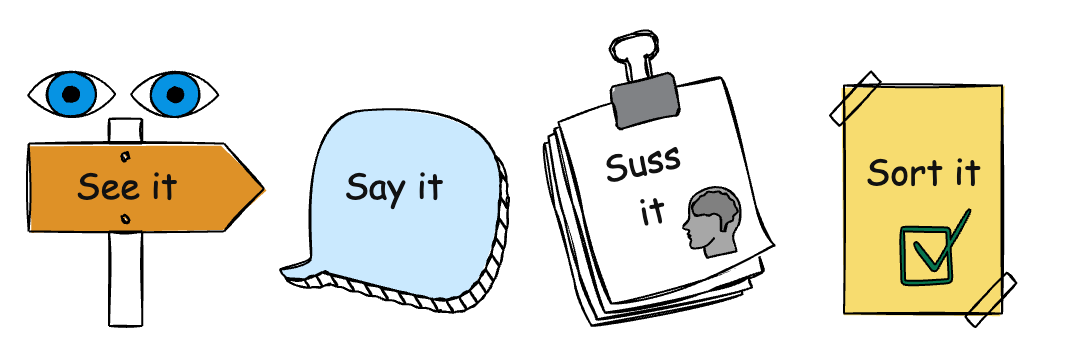
Fault Identification (See it, Say it)
Fault Analysis (Suss it)
Fault Remedy (Sort it)
In this blog post, we explore Fault Analysis (Sort it), which comes under the Risk Management competence:
Was sufficient feedback given to help the pupil understand any potential safety critical incidents?
Types of Faults
There are essentially three types of fault:
Knowledge (Cognitive) – Does the learner know what to do?
Judgement (Psychomotor) – Does the learner know how to do it?
Understanding (Attitude) – Does the learner understand why to do it in a certain way?
For any type of fault, we need to ensure that they have an appreciation of the potential consequences of the fault.
Example: Sam turned right from a major road into a minor road, across the path of oncoming traffic. It was safe to turn right. However, Sam cut the corner as he was turning into the side road.
In this example, an instructor may jump to conclusions and try to come up with a remedy to “sort it” immediately. However, first we need to find out the cause of the fault. There could be several potential causes within each type of fault.
Knowledge (Cognitive) Fault
Perhaps Sam didn’t know that we have to stay on the left side when turning.
Maybe Sam thought that he was turning into a one-way street.
Possibly Sam thought that faded or missing road markings meant that anybody could use any part of the road.
Sam may not have realised that the clutch should be fully up before starting to turn, and the feeling of loss of control may have prompted early steering.
Judgement (Psychomotor) Fault
Sam may not be able to judge when to start steering, and may need reference points to help him to line up the car before turning the wheel.
Perhaps Sam doesn’t know how much to turn the wheel when steering, or can’t judge how fast to turn the wheel.
Maybe Sam is looking at the kerb, hedge, oncoming traffic, the steering wheel, the dashboard or somewhere else when turning, and needs help to understand that it’s best to look at where he wants the car to go.
Possibly, the car drifted to the right before Sam started intentionally turning right, and Sam hadn’t realised that he was steering early.
Perhaps Sam was concerned about changing down to second gear before the turn (or wasn’t sure about the timing) and didn’t complete the gear change properly.
Understanding (Attitude) Fault
Perhaps Sam’s parents always cut the corner when turning right, so he thinks this is how to do it.
Maybe Sam was worried about slowing down too much (especially if there was a car behind) and wanted to get out of the way quickly.
Sam may not have wanted to change gear, so took a route which involved less steering.
Perhaps Sam felt that he could see into the new road and that it didn’t matter if he cut the corner.
Possibly, Sam saw an oncoming car, and wanted to complete the turn before the oncoming car got too close, so that he didn’t have to stop and then get going again.
Fault Analysis (“Suss it”)
You can use structured questioning to find out which type of fault it is. A good structure for this is:
What
Why
How
For example, in this case of cutting the corner when turning right, you could ask:
“What is the routine for turning right into a side road?"
“How do you know when to start steering right?”
“Why is it important to stay on the correct side of the road when turning right?”
The questions do not always need to start with these key words. Here are some examples:
What (Knowledge):
Which side of the road should we use when turning right?
Where on the road should the car be when turning right?
Where should the car be positioned before we start to turn?
How can we tell whether we are turning into a one-way street?
(Note that none of these questions are e.g. “What did you do that for?”)
How (Judgement):
When should we start turning right?
Which way should the wheels be facing before we start to turn?
How can we line up the car to turn right?
What can we use as a reference point for turning right?
Where do we need to look when turning right?
What technique do we use for steering?
Where does the clutch need to be before we start to turn?
When do we need to start the gear change?
(Note that none of these questions are e.g. “How did you manage that?”)
Why (Attitude / Understanding):
What are the dangers of turning onto the wrong side of the road?
What might happen if we cut the corner?
Why is it important to slow down (and change gear) before turning?
How does lining up with the centre line help you to ensure that it’s safe to turn?
(Note that none of these questions are e.g. “Why did you do that?”)
When exploring “why” questions, it is extremely important for learner drivers to understand the potential risks, dangers or consequences of any fault. They need to understand that this fault could lead to a collision, but they need to understand the mechanism behind this collision. For example, if Sam felt that it was safe to cut the corner because there was nobody there, he would need to understand that perhaps he couldn’t really see far enough along the road to make that call, or that he still needs to be able to control the car properly for the times when there is a vehicle emerging from the junction.
Future-focus
When analysing faults, the emphasis needs to be on the future and the positives (i.e. “What will you do differently next time?”) rather than on the past and the negatives (e.g. “What did you do that for then?”). This encourages development, problem-solving and confidence rather than a feeling of deflation or feeling as though they have been “told off”.
Summary
"Suss it" is one of the key learning tools available to a driving instructor. Careful use of structured questioning can help the instructor to identify the root cause of a driver fault, and can help the pupil to understand the potential risks, dangers or consequences of their actions, in a positive and constructive way.
LOCATION
Redruth, Cornwall
CONTACT
info@louisedrivertuition.co.uk
07952 982 993
AREAS COVERED
Redruth, Pool, Camborne, Illogan, Portreath, Lanner, Ponsanooth, Penryn, Falmouth, Carnon Downs, Threemilestone, Chacewater, Blackwater, Truro College, Stithians, Four Lanes, St Day, Mount Hawke
Web Design by Aswonvos
Copyright © Louise Driver Tuition 2026